You probably have a reasonable idea of what you earn and what your everyday life costs. But “How much money will I have a year from now?” is a harder question.
Answering it means connecting your current savings with future income and expenses. Then you can explore what happens if your rent goes up, you take on another recurring payment, or your salary increases.
A simple model is enough to get started. Here is a worked example, followed by a walkthrough of FCF, the iPhone app I’m building.
Start with three numbers
Imagine the following monthly plan. All amounts in this example are in US dollars.
| Item | Amount |
|---|---|
| Starting balance | $10,000 |
| Monthly take-home income | $4,000 |
| Monthly expenses | $3,000 |
That leaves $1,000 each month. If income and expenses stay the same, you will add $12,000 over twelve months. Including your starting balance, you would finish with $22,000.
$10,000 + ($4,000 − $3,000) × 12 = $22,000
This is a starting point. It assumes your income arrives regularly, all spending is accounted for, and your savings earn no interest. The useful part comes when you test those assumptions.
Include the expenses that are easy to forget
Rent, groceries, and transport usually come to mind first. Annual insurance, gifts, holidays, and car maintenance are easier to overlook because they do not arrive every month.
Here is one way to break down the $3,000 monthly total:
| Category | Monthly average |
|---|---|
| Housing and utilities | $1,400 |
| Groceries | $500 |
| Transport | $250 |
| Phone and subscriptions | $100 |
| Other recurring expenses | $350 |
| Allowance for irregular spending | $400 |
| Total | $3,000 |
The allowance accounts for future spending in advance. If a holiday or insurance bill is already included there, do not count it again as a separate expense. A handful of broad categories is enough for your first model. You can refine them later using your bank statements.
Build the plan in FCF
FCF lets you enter a starting balance, add recurring income and expenses, and view a forecast.
- Open Balance and enter $10,000.
- Under Income, add $4,000 in take-home pay, repeating every month.
- Under Expense, add the categories above with the same monthly frequency.
- Open Report and choose a one-year period.
The screenshots below show the English interface with a separate demonstration plan starting at $20,000. They illustrate the screens, rather than the $10,000 worked example above. You can choose a display currency in Settings; changing it does not convert your amounts.
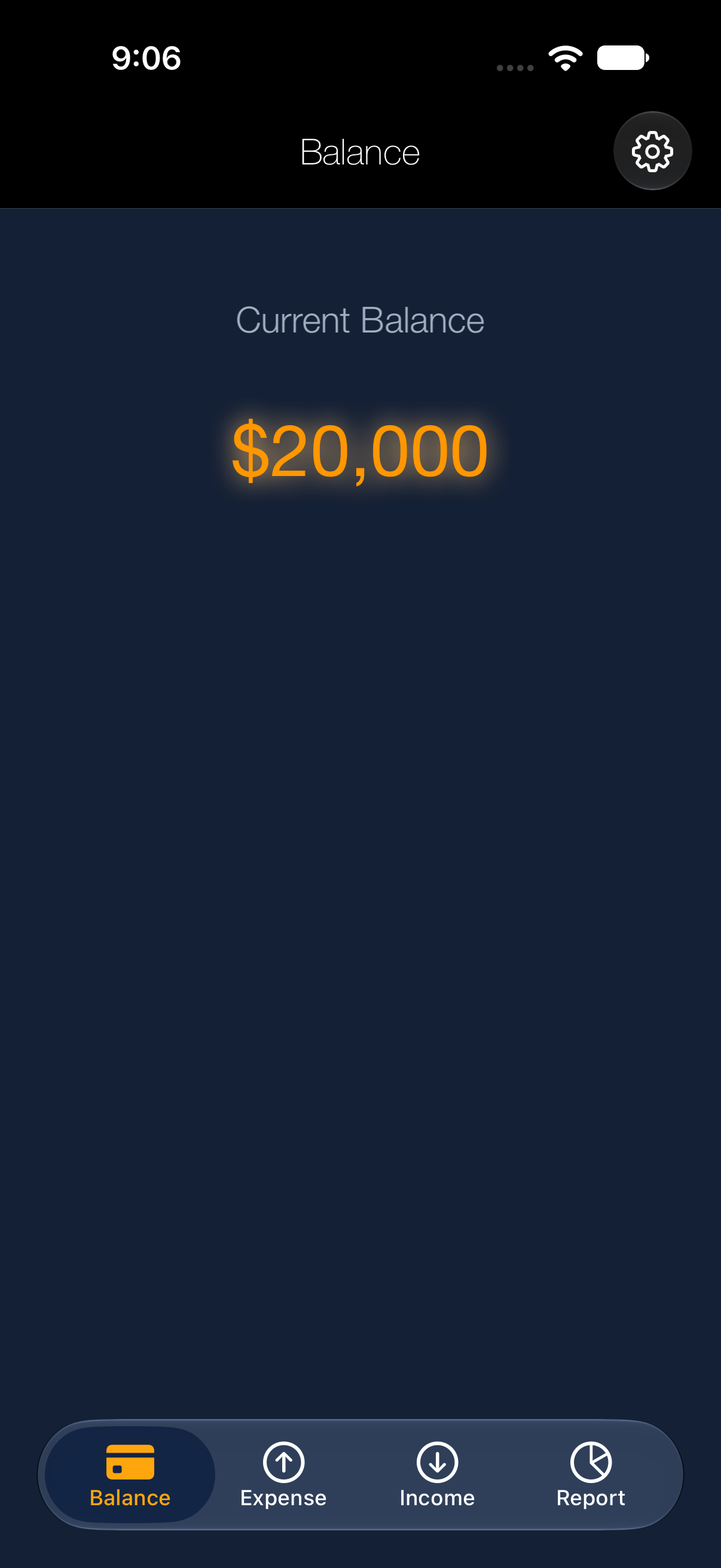
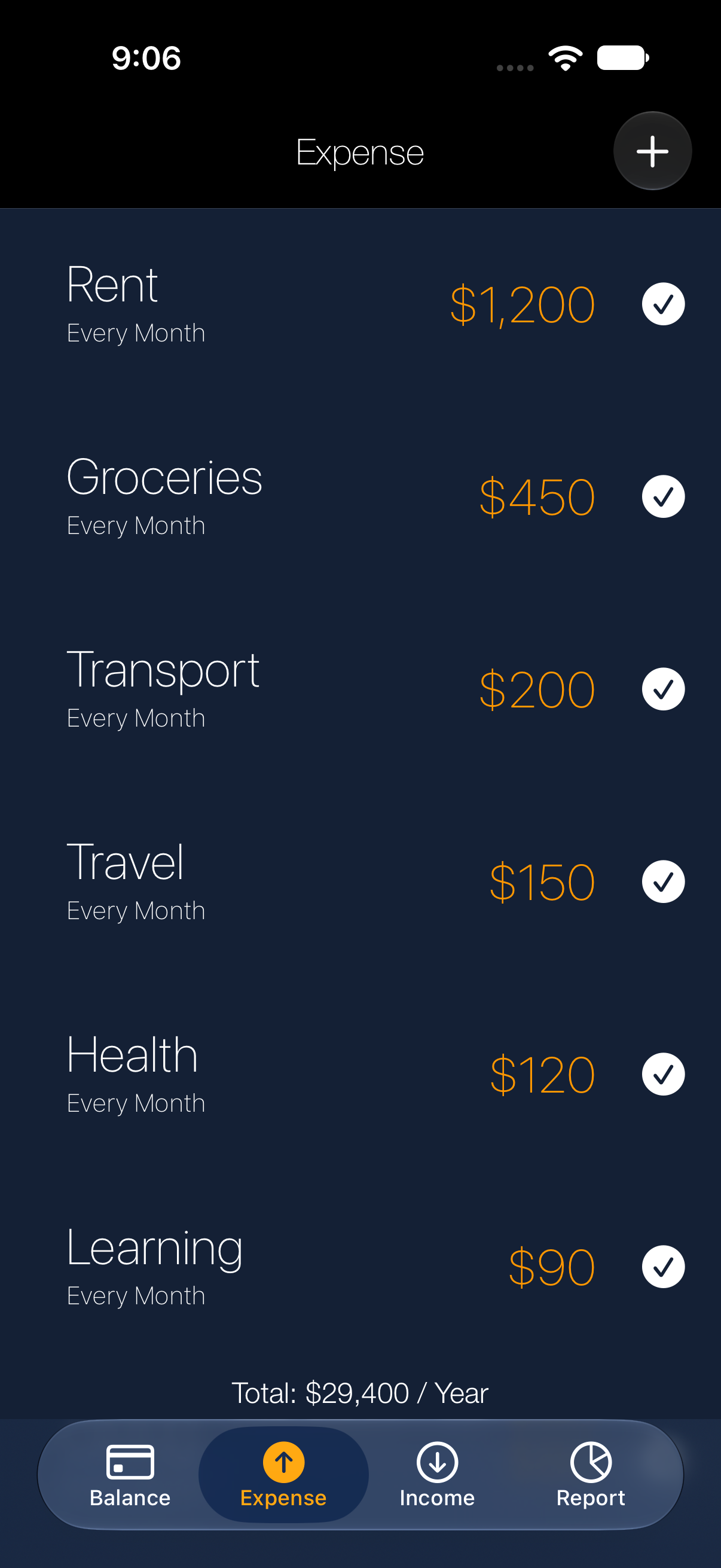
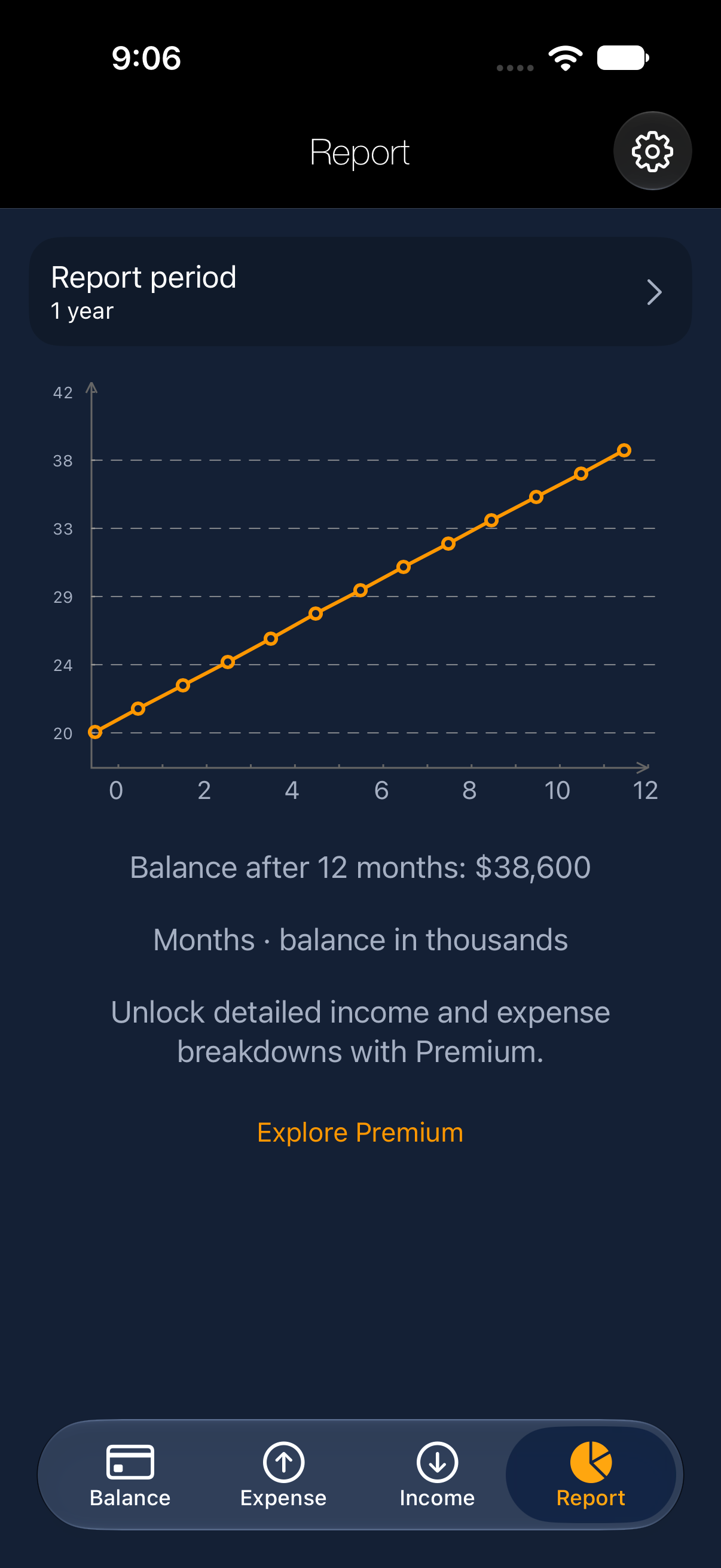
You can now change an assumption and look at the result again. FCF uses approximate time periods, so its forecast may differ from a calculation covering exactly twelve calendar months. Use it to explore scenarios; checking the exact balance on a bill’s due date requires a calendar-based cash ledger.
One decision, several possible outcomes
Back to our worked example. Suppose you are considering an apartment that costs an extra $300 a month.
Update the housing expense in FCF and check the forecast again. In our simple calculation, the monthly surplus falls from $1,000 to $700. The projected year-end balance falls from $22,000 to $18,400.
That makes the trade-off easier to see: the apartment would mean $3,600 less in savings over a full year, with everything else unchanged.
| Scenario | Monthly surplus | After 12 months |
|---|---|---|
| Original plan | $1,000 | $22,000 |
| Housing costs $300 more | $700 | $18,400 |
| Expenses fall by $200 | $1,200 | $24,400 |
| Take-home income rises by $500 | $1,500 | $28,000 |
Each scenario starts at $10,000 and assumes the change lasts the whole year. These figures use the simple twelve-month formula.
The forecast helps you weigh a decision against your priorities. A more convenient apartment might be worth the difference. Or building an emergency fund faster might matter more right now.
Leave room for uncertainty
You will not predict every expense perfectly. Try at least three versions of your plan: your usual spending, slightly higher costs, and lower income.
If the numbers only work under ideal conditions, revisit your expectations. If you still have a cushion in a less comfortable scenario, you have more room to make decisions.
Return to the model once a month to update your balance, adjust expenses, and reconsider your assumptions. Your forecast should evolve with your life.
Try it with your own numbers
Start with your current savings, usual income, and a few major expenses. Look one year ahead. Then change one number that matters to a decision you are making now.
FCF’s six-month and one-year forecasts are free. No account or bank connection is required, and financial data stays on your device. Longer forecasts and annual income and expense breakdowns are available through a one-time Premium purchase.
If the next year looked like this month, would you be happy with the result?